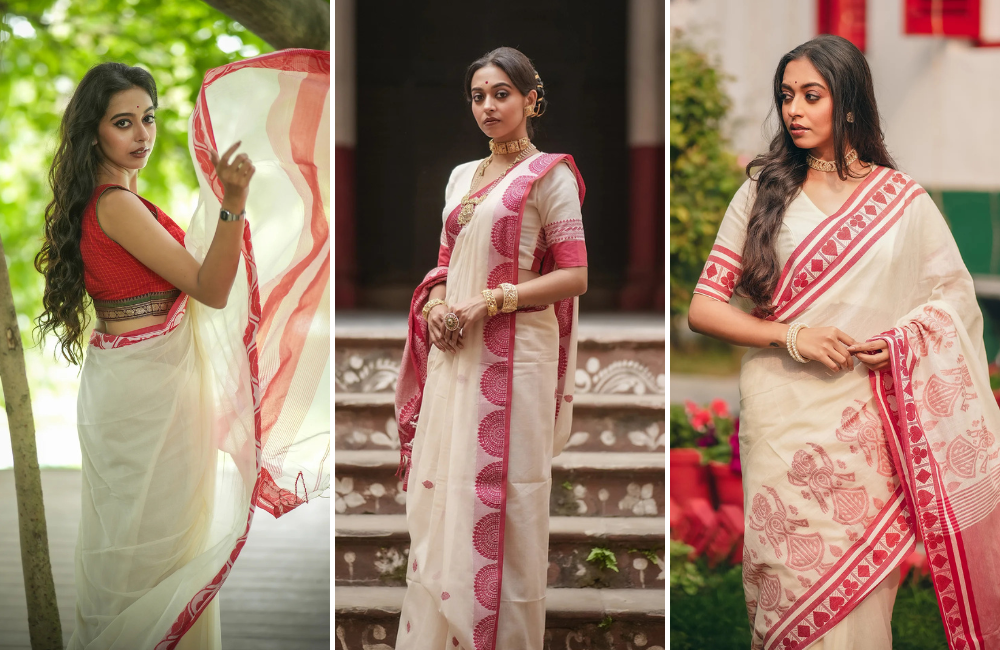
There aren’t many clothes that hit you with the same instant recognition as a lal paar saree. To most people, it’s just a beautiful look, but for Bengali women, it’s the heartbeat of their heritage. It’s the smell of incense and the loud, rhythmic dhaak drums during Durga Puja, or that heavy, expectant silence right before a wedding ceremony begins. Wearing that red border is about carrying a piece of home with you. It’s got this timeless, quiet power that never feels dated.
As a silk or a handloom Jamdani saree, this specific colour combination has transcended fleeting fashion trends for centuries. Let’s take a deep dive to understand its allure.
The Symbolism of Sada and Lal
Colours are rarely chosen for vanity alone in Bengali culture. The colors aren’t just a design choice; they tell a story. The white, or sada, is all about that sense of calm and purity—it’s like a blank slate for the soul. Then you have that bold splash of lal (red) cutting through it. That’s the Shakti piece. It represents feminine strength, fire, and that life-giving energy you see in the Goddess. It’s that balance between total peace and raw power.
When a woman drapes a lal par sada Jamdani saree, she’s essentially embodying a balance of calm and strength. This is exactly why you see everyone wearing it for Sindoor Khela on the last day of Puja. It’s a wild, beautiful mess—as women smear vermillion on each other, the bright red powder starts to blend right into the borders of their sarees. You end up with this moving blur of red and white that’s just pure energy. It’s the ultimate visual of good winning out over evil, played out in real-time.
Origins of Lal Par Sada Saree
Coming to the term ‘lal par’, it literally translates to red-bordered, which refers to the unique red border on the saree. This look actually goes way back in Bengal’s history. Long before synthetic colors existed, people used to dye the borders with natural plants or minerals, like cinnabar.
Over the years, the lal par saree became the go-to for basically every big moment in a Bengali woman’s life—from weddings to those small, important family gatherings. It’s definitely more than just something you’re “supposed” to wear for a festival. When you put one on, you’re connecting back to your grandmother and the women before her. It’s about that sense of pride and feeling like you’re part of a much bigger story.
The Varieties of the Red and White Saree
While the colour scheme remains consistent, the textures and weaving techniques vary significantly across the districts of Bengal.
Garad Silk Saree
The Garad is perhaps the most sacred version. The fabric itself is just pure, raw silk with a classic red border and these little flower motifs we call butis. Since the silk isn’t dyed, it carries a certain spiritual weight. It’s considered clean and untainted, which makes it the standard for any serious religious ritual or traditional Vedic ceremony.
Handloom Jamdani Saree
If the Garad is about purity, the handloom cotton and silk Jamdani is about sheer artistry. This is a fine muslin texture, historically known as the floral art of Bengal.
A white Jamdani with red motifs is a labour of love. The magic here is all in the hands of the weaver. They actually tuck those crimson patterns into the loom one by one using a tiny bamboo needle, which gives the design that famous “floating” look. It’s nothing like a printed saree where the pattern sits on top; with a handloom Jamdani, the art is literally part of the DNA of the fabric.
Tant Saree
The Tant saree is really the best answer to Bengal’s sweltering weather. Because they’re hand-woven from cotton, they’re incredibly airy—perfect for when you have a morning function but it’s 35 degrees outside. A simple white Tant with that bold red border and striped pata work is just iconic. It’s the go-to look for any Bengali woman who wants to look elegant without breaking a sweat.
A Modern Revival
The red and white saree has definitely changed with the times. Instead of just seeing it at weddings or Pujas, you’re seeing designers experiment with it more than ever. Brands like Katha: A Tale of Weaves are taking that iconic palette and bringing it into the modern wardrobe—think trendy dresses and unique Jamdani-style tops. It’s taking a heritage look and making it work for today.
Styling the Icon: The Bengali Drape
The real secret to that red and white look is actually in the drape. Most people in India go for the standard nivi style, but if you really want to show off a Jamdani, you have to go with the traditional Bengali atpoure drape. It’s got this unique way of hanging that just highlights the red border perfectly. It turns a beautiful piece of fabric into a statement.
You can’t really pull off the look without the right finishing touches. First, there’s the big red bindi—it has to be right in the center of the forehead. For married women, the shakha and pola (those iconic white shell and red coral bangles) are a must. Then, you top it all off with some intricate gold filigree jewelry. It’s the perfect time to bring out those heirloom pieces, like a heavy kaan-pasha, to really tie everything together.
The red-and-white combo is still the most loved, hands down. While fast fashion is everywhere, nothing beats the work of an actual weaver from a place like Phulia. That handmade quality offers a connection to our heritage that machines just can’t touch. When you wear one, you’re wearing something more than a saree—it’s a timeless piece of art that’s full of tradition.
FAQs
Can an unmarried woman wear a red and white saree?
Absolutely! Any woman can wear it regardless of their marital status.
What is the difference between a Garad and a Jamdani?
If you want a bit more structure, there’s the Garad. On the other hand, if you want a softer look, you have the Jamdani.
Is the red and white saree only for religious occasions?
While it’s the primary choice for rituals, its timeless grace makes it suitable for any formal occasion.